
IP-PAD was prominently featured at the 48th Annual Meeting of the International Society for Political Psychology (ISPP) in Prague

With more than 15 contributions from the doctoral candidates alone, IP-PAD contributed to the success of the largest annual meeting of the International Society for Political Psychology to date.
Many of the doctoral candidates and supervisors from the IP-PAD team met in Prague from 3rd to 6th July 2025 to attend the ISPP annual meeting. Alongside the sunny summer weather, the in-person reunion featured several highlights. During the conference days, the doctoral candidates not only presented their individual work in talks and posters, but also organised three panels to bring together leading experts to discuss the politics of young people from an interdisciplinary perspective.
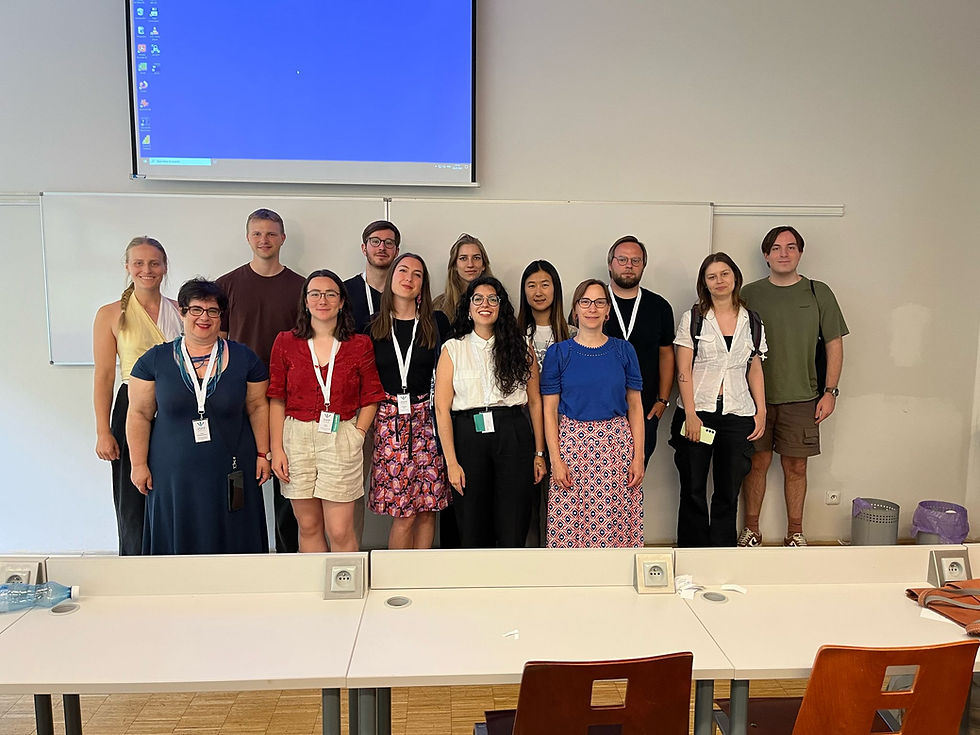
Doctoral candidates, supervisors, and invited guest speakers came together for three organised panels and many more individual contributions from IP-PAD.
Kicking off the events organised by the IP-PAD team, a networking reception brought together researchers from across the world over dinner—an organisational effort led by doctoral candidate Christiana Nika. The reception connected researchers at different levels of their careers to discuss their work and build foundations for collaboration, and also ended with a late-night karaoke session in the vibrant old town of Prague. Beyond the evening networking events, the doctoral candidates organised panels and presented their research throughout all four conference days.
The first IP-PAD panel was organised by Yufang (Arya) Liao and chaired by Anna Knorr, who invited leading researchers from the University College Dublin (Dr. Vivian Liu) and the University of Vienna (Dr. Julia Reiter) to discuss both risks and opportunities in young people's political development—from positive political engagement and peacebuilding, to the risks of radicalisation. The panel also featured Arya presenting her research on how empathy beliefs shape adolescents' political orientations using data from the IP-PAD panel study. Even in the early hours of Sunday morning, the session drew an engaged audience with lively discussions, with Julia Köbrich (Utrecht University) acting as discussant for the panel.
At the same time, Ermioni Seremeta and Olaf Borghi organised and chaired the second IP-PAD session on young people's political agency and voting rights. Researchers with a fond background in political science and psychology presented their work covering topics from how first-time voters' experiences and long-term engagement can be improved (Dr. Laura Serra, London School of Economics and Political Science), to contextual influences (Dr. Katharina Eckstein, Friedrich-Schiller-University Jena) and generational differences (Dr. Kaat Smets, Royal Holloway, University of London) in young people’s support for right-wing parties, and the development of voting quality in childhood and adolescence (Dr. Anna Lang, FernUniversität in Hagen). In the spirit of IP-PAD, interdisciplinary discussions after each talk were led by Manos Tsakiris, scientific lead of IP-PAD, and Kaat Smets, lead of the IP-PAD panel study, with the discussions highlighting novel perspectives and directions for future research.

Doctoral candidate Melina Niraki from the Social and Political Psychology Lab at Panteion University of Social and Political Sciences presenting first cross-country insights from the IP-PAD panel study
Rounding up the conference, Céline Laffineur, Christiana Nika, Irene Arahal, Jakob Kasper, and Melina Niraki organised the final IP-PAD session on the development of the political self in adolescence, with Xenia Chryssochoou (Director of the Social and Political Psychology Lab at Panteion University of Social and Political Sciences) acting as chair and discussant. The panel brought together experts presenting work on political participation profiles among Greek adolescents (Dr. Anna-Maria Mayer, Katholische Universität Eichstätt-Ingolstadt) and the role of critical thinking in shaping political attitudes (Dr. Ales Kudrnac, Institute of Sociology of the Czech Academy of Sciences). Our doctoral candidate, Christiana, also presented her work within IP-PAD exploring social media motivations and democratic engagement among Polish youth. As a final highlight, Melina presented first cross-country insights from data collected in the IP-PAD panel study across all five participating universities, showcasing the network's collaborative research approach.
The many contributions of IP-PAD to the conference highlighted all the efforts and research that have already resulted as part of the MSCA doctoral network and opened up new directions—from exchanges and ideas for collaboration to inspiration for future research within our network with researchers from across the world who work on young people's politics,. We're already looking forward to our next in-person meetings and to ISPP 2026, where IP-PAD will certainly again make a strong contribution!


Comments